Epiphylogenesis and invisible city by Italo Calvino
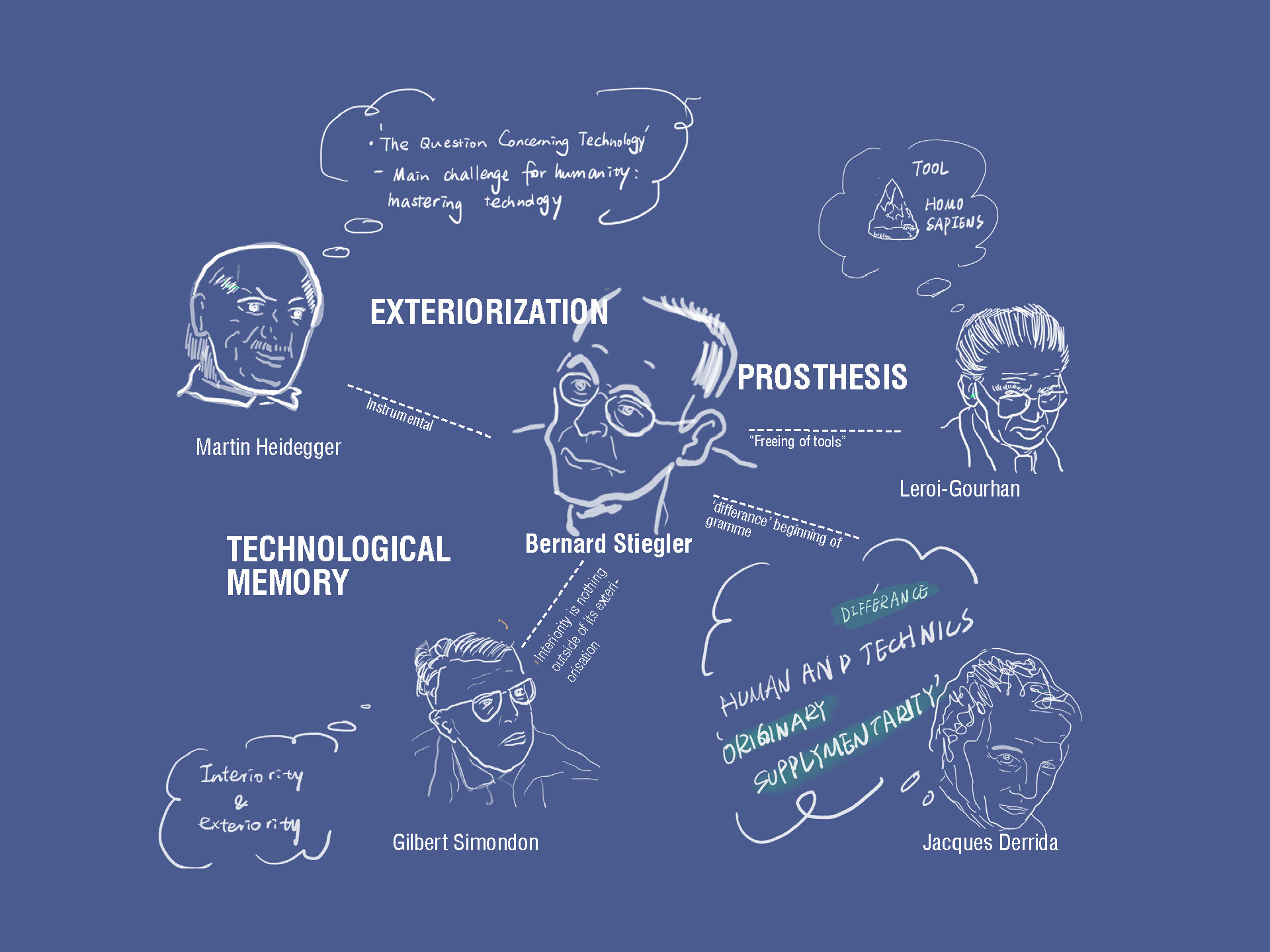
‘Epiphylogenesis’, introduced by French philosopher Bernard Stiegler in his first trilogy: Technics and Time, 1: The Fault of Epimetheus in 1994. Stiegler described epiphylogenesis as the exteriorization of human evolution in which he believed human and technology existed and developed at the same time. Inspired by Martin Heidegger, Leroi-Gourhan, Jacques Derrida and Gibert Simondon, Stiegler figured the epiphylogenesis as the ‘the evolution of prosthesis ’.
According to Stiegler, ‘Epiphylogenesis’ provokes the reflection between technics and human which potentially would lead to an ‘epochal historical rupture’. City, as a civilised object through human evolution, has a similar concept from the co-determination of ‘Epiphylogenesis’. In Italo Calvino’s book Invisible City, the fifty-five cities described by Marco Polo, are the allegory of human experience in the city as a habitation. The city could be a physical container of memory, while it could also be regarded as a mental prosthesis. The city itself has life with the contribution from all the people who live there, whereas people were also influenced by the city to live.
The purpose of this essay is to explain Stiegler’s concept of epiphylogenesis and how this idea could reflect in the Invisible City by Italo Calvino with further relating to the visible city around us. This essay will be divided into three parts. The first part is about Stiegler’s study on Epiphylogenesis. And the second part is a journey by Marco Polo who would lead us to explore the invisible city with three subthemes: City and Memory, Cities and Signs and Continuous Cities. During this journey, we could evidence how the cities and human developed together relating to Stiegler’s idea. This would lead to the third part on how Epiphylogenesis and Invisible city provokes us to think about the visible city in our real life.
 Yaqi Liao